China's wafer manufacturing industry enters a new development cycle — capacity scale continues to climb, domestic firms are the main expansion force, industry structure is optimizing faster, and silicon-based and third-generation semiconductors together open broad growth opportunities.
I. Core Viewpoints at a Glance
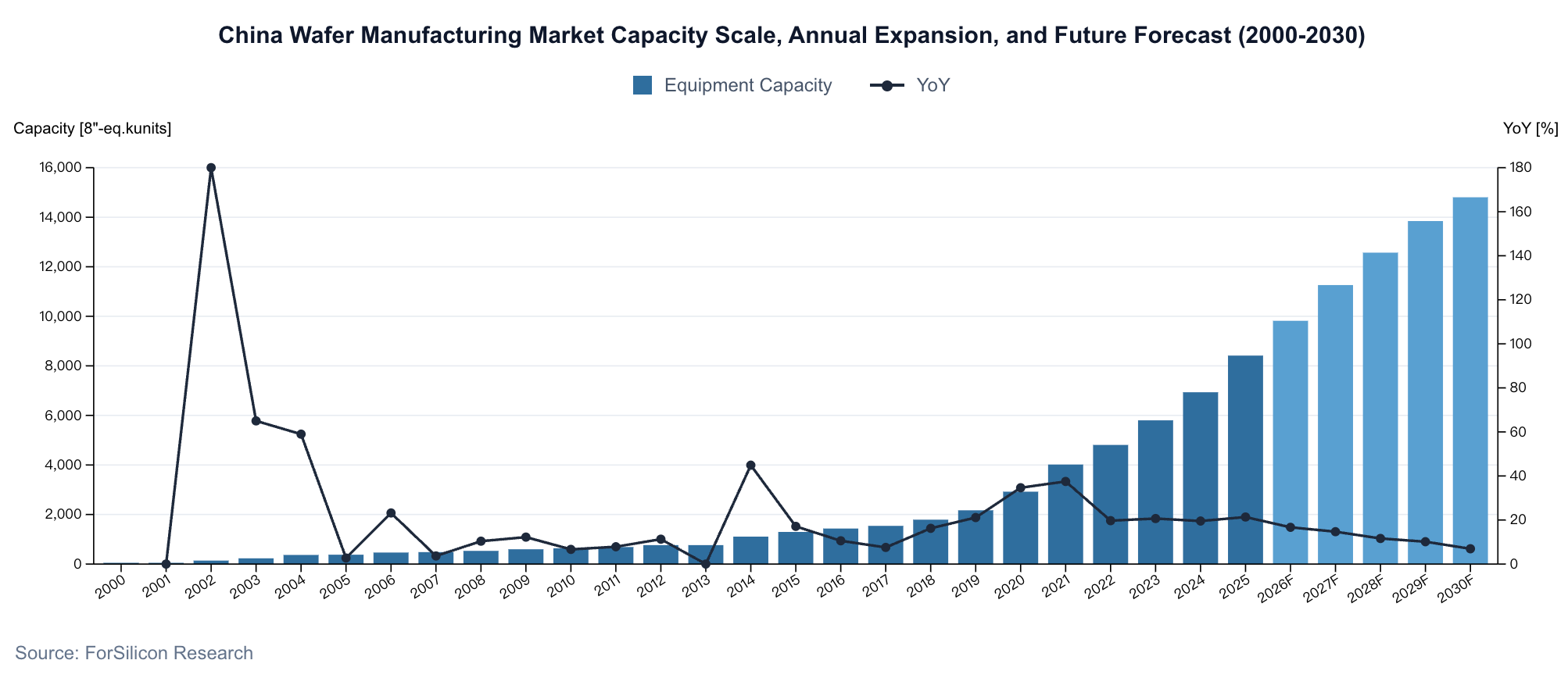
China’s wafer manufacturing industry is undergoing a profound structural transformation, having successfully achieved a historic leap from early capacity scarcity to a global core capacity base. According to ForSilicon Research data, total China wafer manufacturing capacity is expected to exceed 14,800 kunits (equivalent 8-inch monthly capacity; all units in this report follow the same convention) by 2030, up approximately fivefold from about 2,920 kunits in 2020. However, year-on-year growth will gradually ease from the 30%–40% range seen around 2020 to single digits by 2030.
Currently, domestic enterprises are becoming the dominant force in capacity expansion. Domestic capacity is expected to exceed 13,000 kunits by 2030, while foreign-invested capacity will remain below 2,000 kunits — domestic scale will be more than six times that of foreign-invested capacity.
The internal industry structure continues to optimize. Silicon-based wafer fabs form a solid foundation, with 12-inch silicon-based capacity expected to exceed 10,000 kunits by 2030, roughly four times 8-inch silicon-based capacity. At the same time, third-generation semiconductors led by silicon carbide (SiC) are opening a new growth curve, with 8-inch SiC capacity expected to reach about 470 kunits and 6-inch SiC capacity about 1,590 kunits by 2030, demonstrating substantial growth potential.
Industry development logic has shifted from pure scale expansion toward greater emphasis on quality and profitability. Supported by recovering downstream demand, supply–demand conditions remain healthy, with no systemic overcapacity risk. This report aims to provide stakeholders with deep insight into strategic opportunities for China’s wafer manufacturing industry in the new cycle.
II. Industry Background and Evolution: From Catch-Up to Global Core
The development of mainland China wafer manufacturing can be divided into three clear stages. According to ForSilicon Research data, capacity scale and annual expansion forecasts from 2000 to 2030 show continued expansion of total China wafer manufacturing capacity. Total capacity was about 2,169 kunits in 2019; expansion then accelerated markedly, jumping to about 2,920 kunits in 2020 and exceeding 4,000 kunits in 2021. Growth is expected to continue from 2025 through 2030, with total capacity exceeding 14,800 kunits by 2030. However, year-on-year growth will gradually ease from the 30%–40% range around 2020 to about 8% by 2030, reflecting a transition from high-speed growth to steady capacity expansion.
III. Key Insights: Supply–Demand and Structural Shifts in the New Cycle
(1) Supply–Demand Landscape: Domestic Firms Lead Incremental Growth; Foreign Investment Stalls
China’s wafer manufacturing market today shows a clear structural split: “domestic acceleration, foreign stagnation.” ForSilicon Research data show that after 2019, domestic capacity rose rapidly and became the absolute driver of incremental supply. For example, in 2020 domestic capacity was about 1,743 kunits and foreign-invested capacity about 1,178 kunits — still relatively close. By 2024, domestic capacity had exceeded 5,360 kunits while foreign-invested capacity was only about 1,570 kunits, widening the gap to more than three times. By 2030, domestic capacity is expected to exceed 13,000 kunits while foreign-invested capacity will be only about 1,730 kunits — domestic scale more than six times foreign-invested scale — meaning nearly all future incremental domestic supply will be absorbed by local enterprises. By contrast, foreign-invested wafer fabs are largely in a capacity expansion stall, mainly due to global capital allocation and geopolitical constraints. Therefore, all incremental supply in the domestic wafer market will be borne by domestic enterprises, further opening room for domestic substitution.
(2) Industry Structure: Segment Differentiation and New Growth Drivers
The internal structure of domestic wafer manufacturing continues to evolve, with clear differentiation in business models, substrate materials, and wafer sizes. Silicon-based 12-inch capacity anchors the foundation of mainstream logic and memory-adjacent production, while third-generation semiconductors — led by silicon carbide — establish a distinct, fast-growing curve serving automotive, industrial, and energy applications.
IV. Core Industry Trends and Strategic Outlook
1. Domestic substitution remains the defining structural theme
With foreign-invested expansion stalled and domestic capacity absorbing nearly all incremental supply, the localization of equipment, materials, and components becomes both a necessity and a durable opportunity. Firms with genuine technical strength stand to capture outsized share as fabs prioritize qualified domestic suppliers.
2. Industry logic shifts from scale expansion to quality and profitability first
After years of rapid capacity expansion, overall industry capacity reserves are sufficient; future expansion will slow, moving fully away from coarse scale competition. Core development logic shifts from “competing on capacity and share” to “optimizing structure, raising utilization, and improving profitability.” Chips suited to high value-add, high-stability automotive-grade, industrial-grade, and AI applications will become core profit pillars; the industry is moving toward high-quality development.
3. Supply–demand remains healthy; no systemic overcapacity risk
Downstream end-market demand is recovering steadily, absorbing new industry capacity; utilization continues to improve across the industry. Expansion has become more rational, with less disorderly or blind investment. With no new foreign capacity to offset demand, overall supply–demand stays balanced. Over the medium to long term, continued domestic substitution and incremental AI industry demand will absorb domestic incremental capacity; the industry retains strong resilience.
V. Conclusion
China’s wafer manufacturing industry has moved decisively from catch-up to a position of global structural importance. The next cycle rewards precision over scale: understanding which segments, technologies, and suppliers will drive quality growth is now the central strategic question. ForSilicon Research tracks these dynamics continuously — from fab-level capacity and utilization to WFE spend and supplier intelligence — so enterprises and investors can act on data truth they can trust.
About ForSilicon Research. ForSilicon Research focuses exclusively on China's semiconductor equipment, materials, and components — delivering primary-research data and long-term value insight for enterprises and investors. Learn more →